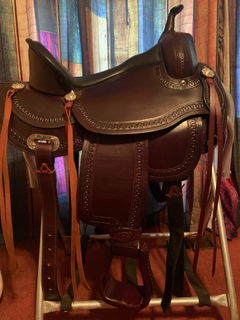
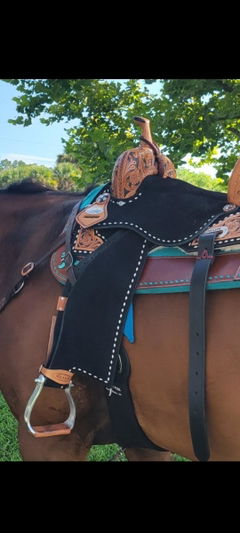
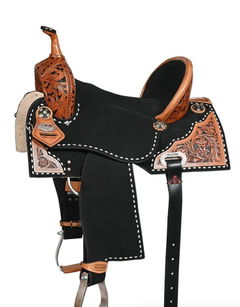
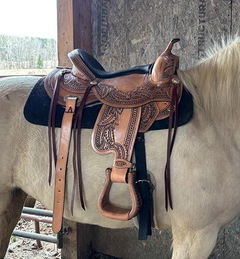
Western Saddles — Trail, Ranch, Barrel & Roping Saddles for Sale
542 productsWestern saddles handcrafted one at a time in full grain harness leather — trail, ranch, roping, barrel racing, gaited and draft builds across flex tree, treeless and traditional tree construction, in seat sizes from 12" to 19".


Western Saddle Buyer’s Guide — Discipline, Tree Type & Seat Fit
Western Saddles for Trail Riding, Ranch Work, Roping, Barrel Racing, Gaited Horses and Draft Breeds
Trail Saddles
Deep padded seats and longer skirts built for comfort over hours in the saddle.
Ranch & Roping Saddles
Strong low horns and full skirts that take the strain of dallying and daily ranch work.
Barrel Racing Saddles
Tall thin horns, high cantles and short rounded skirts for security through tight turns.
Gaited Horse Saddles
Cut to free the shoulder so smooth-gaited breeds keep their natural stride.
Draft & Wide Gullet
Wide gullets and full quarter horse bars for broad-backed and draft-cross horses.
Youth & Pony Saddles
12" and 13" seats scaled for young riders in trail, ranch and barrel builds.
What Actually Makes a Saddle a Trail, Barrel or Roping Saddle?
A common misconception is that tree construction decides discipline. It does not. Flex tree and treeless saddles are both built for trail riding and barrel racing alike. What actually determines the discipline is the shape of the working parts — horn, cantle, seat and skirt. Use this to read any western saddle, ours or anyone else’s.
| Discipline | Horn | Cantle | Seat | Skirt |
|---|---|---|---|---|
| Barrel Racing | Tall and thin, easy to grab | High and deep | Deep, close-contact, often suede | Short and rounded |
| Trail & Pleasure | Moderate, general purpose | Moderate, comfortable for hours | Padded and supportive | Longer, spreads weight |
| Ranch & Roping | Thick and low, built to dally | Lower, freedom to work | Firmer and flatter for mobility | Long and full, spreads load |
| Cutting & Reining | Low and out of the way | Low, free upper body | Flatter, forward, close leg contact | Squared and close-contact |
Swipe the table sideways to see all columns →
Flex Tree vs Treeless vs Traditional Tree
Tree construction is about how the saddle interacts with your horse’s back, not what you ride in. Pick the construction for the horse, then pick the discipline shape for the job.
| Construction | How It Fits | Best For | Trade-off |
|---|---|---|---|
| Flex Tree | Flexes in 4 directions with the horse’s back | Trail, pleasure, barrel, arena work | Less rigid than a fixed tree under heavy pull |
| Treeless | No rigid frame, moulds to the back | High withers, wide shoulders, hard-to-fit horses | Needs a quality pad; not for heavy roping |
| Traditional Tree | Fixed, rigid platform | Roping, ranch work, rodeo, heavy daily use | Must match the horse’s back shape properly |
Swipe the table sideways to see all columns →
Getting Seat Size Right
Seat size is measured from the base of the horn to the leading edge of the cantle. Most adult riders fit a 15" to 17" seat; youth and pony riders fit 12" to 13". Measure your own seat rather than guessing from clothing size — it is the single most common buying mistake.
Three mistakes to avoid: choosing seat size from clothing size instead of measuring; putting a standard-bar tree on a wide or mutton-withered horse; and skipping a proper pad under a flex tree or treeless saddle.
Shop by Discipline
Western Saddle Questions Answered
Browse related: Saddle Pads · Saddle Blankets · Saddle Bags & Trail Packs · Cinches & Girths · Western Tack