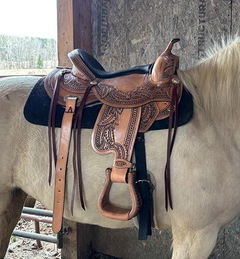
Classic Treeless Saddles — Gen Xniii
119 productsTreeless western saddles built from full grain harness leather — handcrafted one at a time for close contact, natural freedom of movement, and lasting trail comfort.


Classic Treeless Saddles Buyer’s Guide
Hilason Gen Xniii Treeless Saddles — Close Contact Performance for Trail Riding and Everyday Western Work
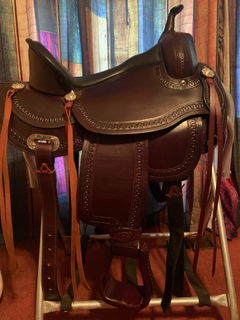
- Full Grain Harness Leather: Every saddle uses top-quality full grain harness leather throughout — the densest, most durable cut of the hide — resisting stretch and cracking through seasons of hard riding.
- Treeless Construction: Without a rigid tree, the saddle base conforms naturally to your horse's back, distributing weight across a broader contact surface and reducing pressure points on shorter-backed or hard-to-fit horses.
- Sheepskin-Lined Fenders: Visible sheepskin lining on fenders and knee rolls cushions the rider's leg during extended trail hours, reducing inner-thigh fatigue without added bulk.
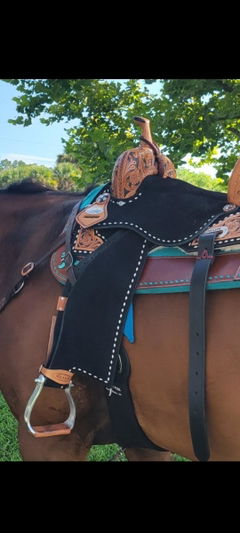
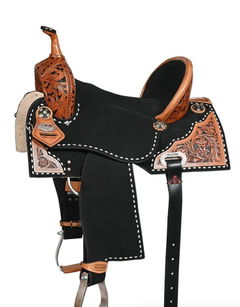
- Hand-Tooled Floral Panels: Deep floral and scroll tooling on swells, fenders, and back jockey — finished in contrasting red-on-dark leather with silver concho accents and lace edging for show-quality visual appeal.
- Chocolate Suede Seat: The roughout suede seat provides grip and security through transitions and terrain changes, keeping the rider centered without relying solely on leg pressure.
- Handmade One at a Time: Each saddle is assembled individually — not mass-produced — allowing closer quality control at every construction stage from skirt shaping to final rigging placement.
- Trusted Across 48 States: Over 20,000 Hilason saddle owners nationwide — high-performance at accessible pricing with no premium markup for the name alone.
How to Choose the Right Treeless Western Saddle
Horse Back Shape & Fit
Treeless saddles work best on horses with well-defined withers and a symmetrical topline. Because there is no rigid tree to set gullet width, the saddle panel spreads load more broadly — making these a popular choice for wide-backed, mutton-withered, or short-backed horses that struggle with standard treed fit. Always check that the saddle sits level and that there is clearance over the spine before cinching down.
Rider Discipline & Use Case
The Gen Xniii collection is built for trail riding, recreational western riding, and riders who prioritize close contact and feel over the lateral support of a deep-skirted ranch saddle. The lightweight profile reduces fatigue on long single-track rides, and the suede seat keeps the rider secure without a high cantle. Riders who want maximum leg contact with their horse will find treeless construction delivers a noticeably more connected feel.
Seat Size
Hilason Gen Xniii saddles are available in multiple seat sizes across the collection. As a general starting point, measure from the base of your tailbone to the back of your knee — most adult riders fall between 15 and 17 inches. If you sit between sizes, size up for comfort on long trail rides. Check individual product pages for the size options available on each style.
Common Mistakes When Buying a Treeless Saddle
Two errors come up repeatedly: assuming treeless saddles fit every horse automatically (they still require back-shape assessment, particularly on very narrow or asymmetrical horses), and choosing seat size by weight alone instead of actual thigh-to-seat measurement. A properly sized seat prevents the rider from perching forward and allows the saddle to balance correctly on the horse's back.
What Riders Notice After Switching to a Treeless Saddle
The most consistent feedback from riders who move from a traditional treed western saddle to a treeless design is how much more of the horse's movement they can feel. Without a rigid tree dampening torsion, lateral bend and rhythm come through the seat more directly — many trail riders describe it as closer to bareback riding but with the security of stirrups and a horn. On longer rides, the reduced overall saddle weight is noticeable by mid-afternoon. Horses that previously showed signs of back tension — short-stepping, tail swishing, reluctance to move forward — are often more forward and relaxed once saddle pressure is redistributed by the treeless panel. That said, a quality saddle pad remains essential: without a tree to bridge the contact surface, pad thickness and density play a bigger role in protecting the horse's back.
Treeless vs Treed Western Saddle — Which Is Right for Your Riding?
Treeless Western Saddle
A treeless saddle has no internal wooden or fiberglass tree — the seat and panels flex with the horse's movement rather than holding a fixed shape. This design delivers closer contact, a lighter overall weight, and more adaptable fit across different horse body types. Best for: trail riding, recreational western, horses that are difficult to fit with standard tree widths.
Flex Tree Western Saddle
A flex tree saddle retains the structural framework of a traditional tree but uses a flexible material — typically a composite or polymer — that allows 4-way movement in response to the horse's back. This provides the lateral support and defined seat shape of a treed saddle while still adapting to back flexion. Best for: riders who want the feel of a traditional western saddle with more give, working cattle, ranch riding. Browse our Flex Tree Saddles collection for more options.
Traditional Treed Western Saddle
A saddle built on a rigid tree offers maximum lateral support, a consistent gullet shape, and the structural stability needed for roping, cutting, and heavy ranch work. Fit is more precise — the tree width must match the horse's shoulder angle — but the result is a saddle that holds its shape under load and over years of use. See the full Western Saddles collection for treed options.